 English
 简体中文
简体中文
 ru
ru
 es
es

How does a solenoid valve work?
Introduction:
In industrial automation, irrigation systems, medical equipment, and even household appliances, solenoid valves are ubiquitous and crucial control components. They act like switches in fluid pipelines, directing the flow of various media, such as water, gas, and oil. But have you ever wondered how this often inconspicuous component actually works? This article will provide an in-depth analysis of the solenoid valve, revealing its internal structure and operating principles.
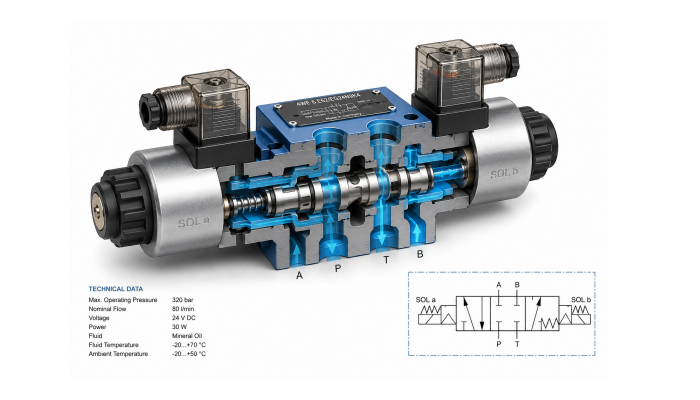
Hydraulic solenoid valve technical illustration
What is a Solenoid Valve?
A solenoid valve is a fundamental automation component that uses electromagnetic force to control the flow or direction of fluids (liquids and gases). It typically consists of two main components: a solenoid coil and a valve body. When the coil is energized, it generates a magnetic field, actuating mechanical components within the valve body, thereby changing the valve’s open or closed state.
Core Components
To understand its operating principle, we first need to understand its internal structure. A typical direct-acting solenoid valve consists of the following components:
1.Body:
The main structure of the valve, with an inlet port and an outlet port, serves as a fluid passage.
2.Solenoid Coil:
An electromagnet made of wound copper wire, it serves as the valve’s power source. It generates a magnetic field when energized and dissipates when de-energized.
3.Plunger/Armature:
A movable ferromagnetic metal core located within the coil. It is the direct target of the magnetic field and acts as the “piston” that actuates the valve.
4.Pilot:
Connected to the plunger, the seal at its end opens or closes the fluid passage.
5.Seal:
Typically made of an elastic material such as rubber or polytetrafluoroethylene, it ensures a leak-proof seal when the valve is closed.
6.Spring:
When the coil is de-energized, the spring provides a restoring force, pushing the plunger and valve core back to their default position.
7.Orifice:
The passage through which fluid flows.

Solenoid valve internal structure diagram
Working Principle: The Magic of Power On and Power Off
The operation of a solenoid valve follows a clear physical process, centered on the principle that “electricity generates magnetism, and magnetism generates force.”
1. De-energized State (Normally Closed Solenoid Valve)
In the de-energized default state, the spring pushes the plunger and valve core downward, forcing the seal on the valve core to tightly cover the orifice. In this state, fluid entering the inlet is blocked from flowing to the outlet, and the valve is in the closed state.
(Hint: A diagram showing the spring compressed and the seal blocking the orifice can be included here.)
2. Energized State
When current flows through the solenoid coil, it generates a strong magnetic field.
This magnetic field attracts the ferromagnetic plunger inside, which overcomes the spring force and fluid pressure and moves upward.
The valve core connected to the plunger is also lifted, and the seal moves away from the orifice, opening a passage. Fluid can flow from the inlet through the orifice to the outlet, and the valve is in the open state.
(Hint: A diagram showing the plunger being attracted and fluid flowing can be included here.)
Once the current is turned off, the magnetic field instantly disappears, and the spring force immediately pushes the plunger and valve core back to their original position, reclosing the orifice and cutting off fluid flow.
In simple terms: When power is on, the valve opens; when power is off, the valve closes. This process responds extremely quickly, typically in milliseconds.

Solenoid valve working principle diagram
Main Types: Direct-Acting vs. Pilot-Operated
The principle described above is the simplest direct-acting solenoid valve. It relies on electromagnetic force to directly open the main orifice and is suitable for small pipelines and lower pressures.
For larger diameters and higher pressures, pilot-operated solenoid valves are more common. Their operating principle is slightly different:
They use the pressure of the fluid in the pipeline to open or close the main valve.
The solenoid coil first controls the opening and closing of a small pilot orifice.
The opening and closing of the pilot orifice creates a pressure differential between the upper and lower chambers of the valve diaphragm or piston, which in turn drives the main valve open and close.
Advantages: A small solenoid coil can control large flow rates, resulting in energy efficiency and high efficiency.
Common Application Scenarios
Once you understand the principles, it’s easy to understand why solenoid valves are so important:
1.Industrial Automation:
Control pneumatic cylinders, hydraulic systems, and sprinkler systems.
2.Home Appliance Industry:
Control the flow of water in washing machines and dishwashers.
3.Irrigation Systems:
Automatically control watering in different areas.
4.Medical Equipment:
Precisely control the flow of gas and liquid in ventilators and dental chairs.
5.Automotive Industry:
Transmission Control, Exhaust Gas Recirculation (EGR) Systems.
Conclusion
Although small, solenoid valves are the unsung heroes of modern automation. Their ingenious design converts electrical energy into magnetic energy, then precisely controls fluid flow through mechanical action, achieving the effect of “controlling large quantities with small components.” Whether it’s a simple direct-acting valve or a complex pilot-operated valve, their core lies in the sophisticated application of electromagnetic principles.
We hope this article has provided you with a deeper understanding of this critical component: the solenoid valve. If you have any questions regarding selection or application, please feel free to contact our expert team for professional advice!
Need help choosing the right solenoid valve?
Contact our technical team today.
