 English
 简体中文
简体中文
 ru
ru
 es
es

OEM vs Aftermarket Solenoid Valve Coils: What’s the Difference?
When a solenoid valve coil fails, procurement and maintenance teams face a familiar decision: replace it with an Original Equipment Manufacturer (OEM) part, or switch to an aftermarket alternative. The choice affects more than just the purchase price — it impacts equipment reliability, lead times, warranty coverage, and total cost of ownership over the life of the system.
This guide breaks down the real differences between OEM and aftermarket solenoid valve coils, so you can make the right call for your application, budget, and risk tolerance.
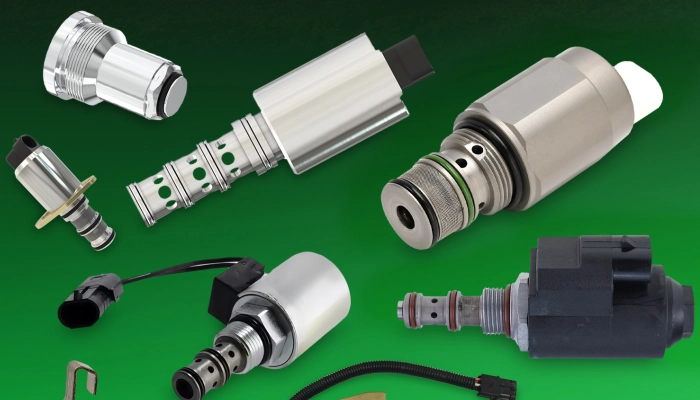
OEM vs aftermarket solenoid valve coil
What Is an OEM Solenoid Valve Coil?
An OEM solenoid valve coil is manufactured by — or under direct specification from — the original equipment maker that produced the valve or system it’s installed in. These coils are built to match the exact electrical, dimensional, and performance specifications of the original part, which means fit and function are effectively guaranteed.
OEM coils typically come with manufacturer warranties and are tested against the same quality benchmarks used in the original production run.
What Is an Aftermarket Solenoid Valve Coil?
An aftermarket solenoid valve coil is produced by a third-party manufacturer rather than the original equipment maker. These coils are designed to be compatible with specific valve models or series, often at a lower price point than OEM equivalents.
Quality varies significantly across the aftermarket space. Some manufacturers use comparable materials and tight tolerances; others cut corners on insulation, winding consistency, or coil housing durability to hit a lower price.
Key Differences Between OEM and Aftermarket Coils
| Factor | OEM Coils | Aftermarket Coils |
| Price | Generally higher | Typically 20–50% lower |
| Quality consistency | Standardized, tightly controlled | Varies by supplier |
| Fit & compatibility | Guaranteed match | Usually compatible, but verify specs |
| Lead time / availability | Can be longer, especially for older equipment | Often more readily stocked |
| Warranty | Backed by original manufacturer | Varies; some offer comparable coverage |
| Certifications | Matches original equipment standards | Should be verified per supplier |
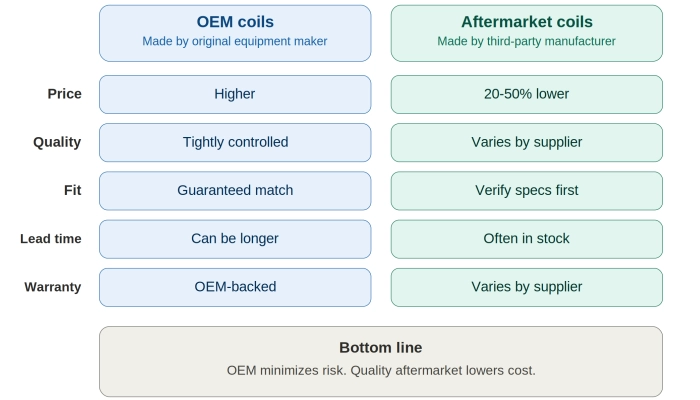
Comparison chart of OEM vs aftermarket solenoid valve coils by price, quality, fit, lead time, and warranty
OEM Coils: Pros and Cons
Advantages
- Exact fit and performance match to original specifications
- Manufacturer-backed warranty and accountability
- Lower risk of compatibility or installation issues
- Often required to preserve warranty on the broader system
Drawbacks
- Higher unit cost
- Longer lead times for discontinued or specialty equipment
- Limited supplier options can affect pricing leverage
Aftermarket Coils: Pros and Cons
Advantages
- Lower cost, especially valuable for high-volume replacement needs
- Often better stock availability and faster shipping
- More supplier choice, which can improve negotiating position
- Quality aftermarket coils can match OEM performance for many applications
Drawbacks
- Quality varies between manufacturers — due diligence is required
- May void OEM warranty on the host equipment
- Verifying electrical specs (voltage, resistance, duty cycle) and certifications falls on the buyer
How to Choose the Right Coil for Your Application
The right choice depends on the specifics of your equipment, budget, and risk profile. A few practical guidelines:
- Equipment still under warranty:Stick with OEM coils to avoid warranty disputes.
- Critical or safety-related systems:OEM or a well-certified aftermarket equivalent with documented testing is the safer route.
- High-volume replacement or maintenance budgets:Aftermarket coils from a reputable, certified supplier can deliver significant savings without sacrificing reliability.
- Discontinued or hard-to-source OEM parts:Aftermarket may be the only practical option — prioritize suppliers who can confirm exact electrical and dimensional specs.
- Mission-critical uptime requirements:Weigh the cost of a coil failure (downtime, safety risk) against the savings of going aftermarket.
In short: OEM minimizes risk and guarantees compatibility, while a quality aftermarket coil can offer comparable performance at a lower cost — provided the supplier is transparent about specifications, testing, and certifications.
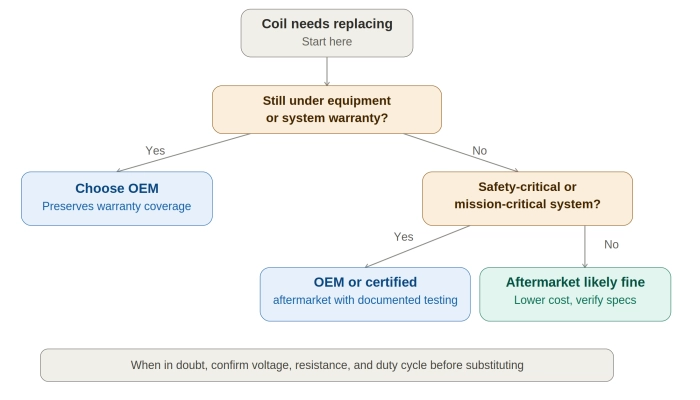
Decision flowchart for choosing OEM or aftermarket solenoid valve coil replacement
Frequently Asked Questions
Q:Are aftermarket solenoid valve coils as good as OEM?
A:Quality aftermarket coils from reputable manufacturers can match OEM performance in most standard applications. The key is verifying that voltage, resistance, duty cycle, and certifications align with your equipment’s requirements.
Q:Will using an aftermarket coil void my equipment warranty?
A:It depends on the manufacturer’s terms. Some OEMs explicitly require original parts to maintain warranty coverage; others allow third-party components as long as performance specs are met. Check your warranty documentation before substituting parts.
Q:How do I know if an aftermarket coil is compatible with my valve?
A:Match the coil’s voltage, frequency (AC/DC), resistance, connector type, and physical dimensions to your existing coil or valve manufacturer’s specifications. Reputable aftermarket suppliers provide cross-reference charts or compatibility guides.
Q:Why are aftermarket coils cheaper?
A:Aftermarket manufacturers don’t carry the original equipment brand premium and often operate at larger production scales across multiple valve platforms, which lowers per-unit costs.
Final Thoughts
There’s no universal right answer between OEM and aftermarket solenoid valve coils — the best choice depends on your equipment’s criticality, your maintenance budget, and how much risk you’re willing to absorb in exchange for cost savings. For warranty-sensitive or safety-critical systems, OEM remains the lower-risk path. For routine maintenance and high-volume replacement needs, a certified aftermarket coil can deliver reliable performance at a fraction of the cost.
Need help identifying the right coil for your application? [Reach out to our team] for a compatibility check and a quote tailored to your equipment.
