 English
 简体中文
简体中文
 ru
ru
 es
es

How to Find the Right Solenoid Valve Part Number for JCB, CAT, Bobcat, John Deere, Case & New Holland
If you’re sourcing a replacement solenoid valve for JCB, Caterpillar (CAT), Bobcat, John Deere, Case, or New Holland equipment, you’ve probably run into the same problem: each brand uses a completely different part numbering system. The same type of valve can look like a totally different code depending on the manufacturer, which makes it easy to search for the wrong part — and order the wrong one.
This guide covers:
- How part numbers are structured across these six brands
- How to pull accurate identifying information from your old valve or machine plate
- The most common mistakes buyers make when cross-checking part numbers
- What to do when you can’t find a match
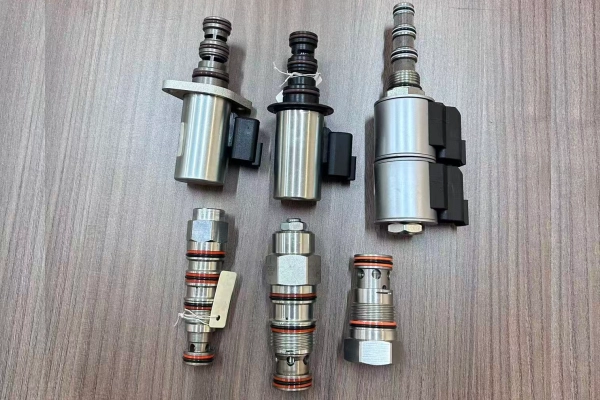
Solenoid valves from different brands can look almost identical, but each manufacturer uses a completely different part numbering system
Why the Numbering Systems Are So Different
In construction and agricultural equipment, almost every OEM runs its own parts coding system. This isn’t an oversight — each manufacturer’s parts management system was built independently over decades, and there’s no industry-wide standard tying them together. That’s also why a single “universal cross-reference table” is hard to produce responsibly: it’s not that the data hasn’t been compiled, it’s that the underlying logic genuinely doesn’t map across brands.
Knowing the general format for each brand at least helps you figure out which manufacturer a part belongs to before you start searching:
JCB JCB part numbers are typically written in two segments separated by a slash, e.g. 25/xxxxxx, 716/xxxxxx, 928/xxxxxx. The first segment usually indicates a broad parts category (the “25” series commonly appears on hydraulic valve components), and the second is the specific item number. You’ll sometimes see the same number written without the slash (e.g. 25xxxxxx) — it’s the same part.
CAT (Caterpillar) CAT electrical and solenoid components are often labeled with an alphanumeric part number, and the packaging frequently shows both the CAT part number and the original manufacturer’s number from whichever component supplier produced it (Bosch and Parker are common OEM suppliers for hydraulic components in CAT equipment). If a supplier only gives you the component manufacturer’s code, ask for the matching official CAT part number too — otherwise you may not be able to look it up in CAT’s own parts catalog later.
Bobcat Bobcat electrical part numbers are usually 7 digits, with letter suffixes on some older models to indicate a revision. Bobcat updates its lineup fairly frequently, so the same valve position on the “same model” can carry a different part number depending on the serial number range — the serial number matters more than the model name alone.
John Deere Common prefixes include AT, RE, and TY (e.g. ATxxxxx, RExxxxx), and different prefixes generally correspond to different internal parts classification systems (John Deere’s agricultural and construction lines don’t always follow identical prefix conventions). John Deere’s official parts catalog typically requires the machine’s serial number (PIN) to return an accurate match — this is more strictly enforced than with some other brands.
Case Case’s agricultural line (Case IH) and construction line (Case Construction) don’t share one unified parts system, even though both fall under the same parent company. Before cross-checking a part number, confirm which product line the customer’s machine belongs to, or you risk searching the wrong catalog entirely.
New Holland New Holland and Case both sit under CNH Industrial, and some underlying components — including certain solenoid valves — are shared between the two brands. That said, shared ownership doesn’t automatically mean parts are interchangeable. Whether a specific part is actually shared should be confirmed against the part number itself, not assumed from the brand relationship.
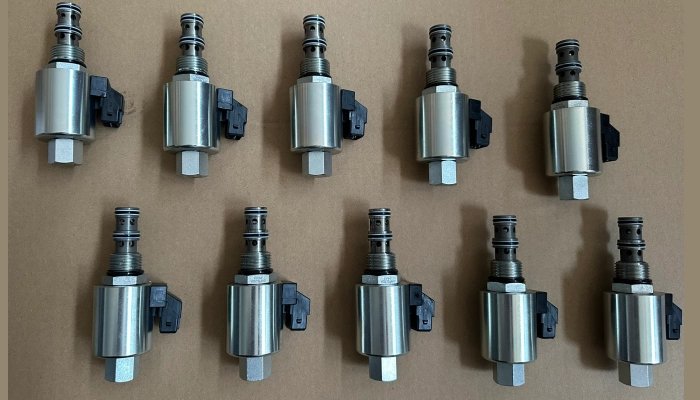
Where the part number is stamped varies by brand — check carefully before reading off a number
The 3-Step Method for Cross-Checking a Part Number
Step 1: Start with the machine, not the old part
It’s tempting to just read off the number stamped on the old valve, but that part may not be original equipment, or it may have been swapped at some point during the machine’s life — meaning the number on it doesn’t necessarily match what should currently be installed. A more reliable sequence:
- Find the machine’s identification plate (usually inside the cab, on the frame, or near the engine compartment) and record the full model name and serial number / PIN
- Then read the number stamped or labeled on the old valve itself as supporting information
- Send both pieces of information to your supplier together — this is far more reliable than either one alone
Step 2: Pay attention to serial number ranges, not just the model name
Within the production run of a single model — say, a particular generation of JCB 3CX or a John Deere excavator — the solenoid valve part number often changes partway through, due to a supplier switch, a design revision, or an emissions-related electrical update. So the model name alone isn’t enough to determine the correct part; the serial number range is usually what actually decides it.
Step 3: Send photos, not just text
If you still have the old part, photograph these angles before sending it to a supplier for confirmation:
- The number stamped or laser-etched on the valve body (often on the side or top)
- Any label on the solenoid coil itself (on split-design valves, the coil and the valve body may carry separate numbers)
- A close-up of the port/flange connection type (threaded and flanged connections are not interchangeable)
- An overall shot with something for scale (a coin or hand next to the part helps with size reference)
Text descriptions are easy to get wrong — smudged stamps, grease covering digits, or simple transcription errors. Photos cut that risk down significantly.
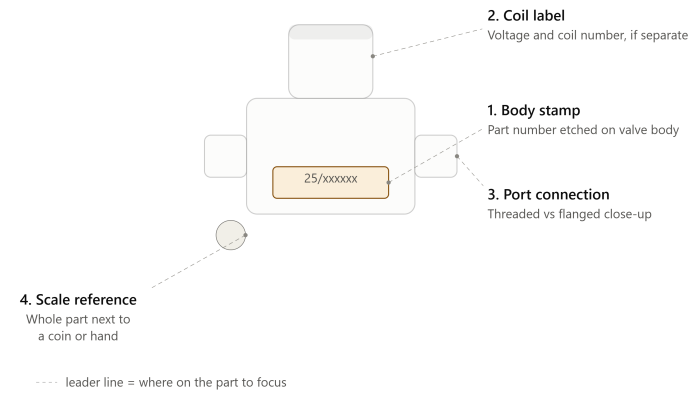
Before cross-checking a part number, photograph these four angles for the most reliable result
Common Mistakes to Avoid
Assuming “same brand, same series” means interchangeable Even two machines with adjacent serial numbers can end up with different part numbers if there was a design change (an engineering change notice, or ECN) partway through the run. Brand and series name narrow things down, but they don’t replace checking the actual serial number.
Ordering based on a keyword search alone A lot of part-number information online comes from third-party parts sellers who compiled it themselves, and accuracy varies a lot — some of it has simply been copied from one site to another. Treat search results as a lead, not a confirmed answer, and verify against the machine’s serial number before ordering.
Overlooking voltage A 12V and a 24V version of the same valve can look identical — same housing, same mounting — but they are not interchangeable. Always confirm the voltage spec when cross-checking a part.
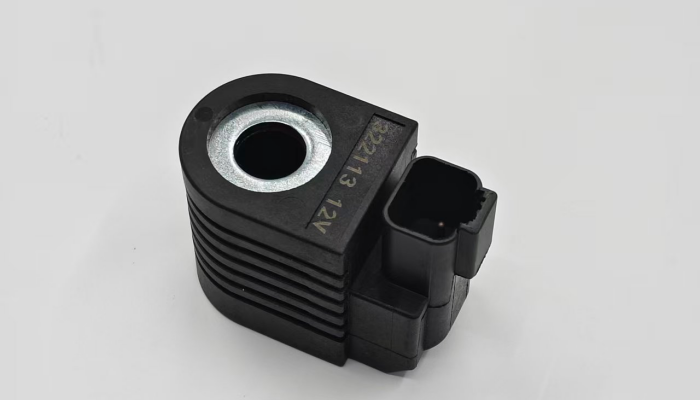
12V and 24V coils look the same except for the voltage printed on the label — using the wrong one means the valve won’t work
If You Can’t Find a Match
With six brands, multiple product lines, and decades of model years in play, it’s normal to hit a part number you can’t immediately place — that doesn’t mean no match exists. In that situation, the fastest path is usually to pull together the machine’s ID plate info, the serial number range, and photos of the old part, and send it to a supplier who works with these brands regularly — that’s typically quicker and more accurate than continuing to search on your own.
If you need to cross-check a solenoid valve part number for JCB, CAT, Bobcat, John Deere, Case, or New Holland equipment, send us the machine model, serial number, and a photo of the old part — we’ll confirm the correct part number within 3 business days.
