 English
 简体中文
简体中文
 ru
ru
 es
es

Solenoid Valve Coil Voltage Resistance Chart
If you’ve pulled a solenoid coil off your machine and want to know whether it’s actually bad, the fastest check is comparing its voltage rating and resistance reading against a typical range. This guide explains what those numbers mean, how to test them yourself, and what to do if your reading falls outside the normal range.
Voltage and resistance specs vary by exact model, coil design, and production year — even within the same brand. The ranges below are for a quick first check, not a substitute for confirming against your machine’s OEM part number. If you want an exact figure for your specific model, send us your machine details or a photo of the old part and we’ll confirm the correct spec before you order.
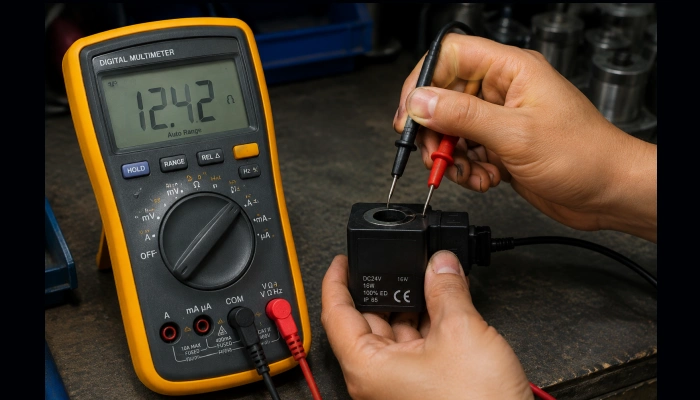
testing solenoid valve coil resistance with a multimeter
Why Voltage and Resistance Matter
A solenoid coil is essentially a wire wound tightly around a core. Two numbers determine whether it will work correctly on your machine:
- Voltage rating— the coil is built to run on either 12V or 24V. Feed it the wrong voltage and it will either fail to generate enough magnetic pull to actuate the valve, or draw too much current and burn out.
- Resistance (measured in ohms, Ω)— this tells you the condition of the coil winding itself. A reading dramatically outside the normal range for that coil almost always means the winding has failed internally, regardless of what’s happening with the wiring or ECU.
Checking both together is what actually tells you whether a coil is good — checking only one can give you a false pass.
How to Test Coil Resistance Yourself
- Disconnect the solenoid connectorfrom the coil (with the machine off).
- Set your multimeter to the resistance (Ω) setting.
- Touch the probes to the two coil terminals— polarity doesn’t matter for this test.
- Record the readingand compare it against the typical range for that coil type below.
- If unsure, test a known-good coil first(from the same machine or a matching new part) to establish a baseline before condemning the old one.
Typical Voltage & Resistance Ranges
These are general reference ranges seen across common heavy-equipment hydraulic solenoid coils — not brand-specific guarantees. Use them as a first checkpoint, then confirm against your exact part number for anything approaching a purchase decision.
| System Type | Typical Voltage | Typical Coil Resistance | Notes |
| Compact/mini excavators, skid steers | 12V | Roughly 5–15Ω | Wide variation by coil design and manufacturer |
| Mid-to-large excavators, wheel loaders | 12V or 24V | Roughly 5–30Ω | Larger machines more often run 24V systems |
| Backhoe loaders | 12V or 24V | Roughly 5–30Ω | Varies by model year and ECU generation |
| Agricultural tractors | 12V | Roughly 5–20Ω | Some export/regional models differ |
A reading of 0Ω (dead short) or an infinite/open reading (no continuity at all) reliably indicates a failed coil, regardless of brand or model — those two results fall outside every normal range and don’t require brand-specific confirmation to diagnose.
For anything in between — a reading that seems slightly high or low but not clearly broken — that’s when it’s worth confirming against the specific coil’s OEM spec rather than guessing from a general range.
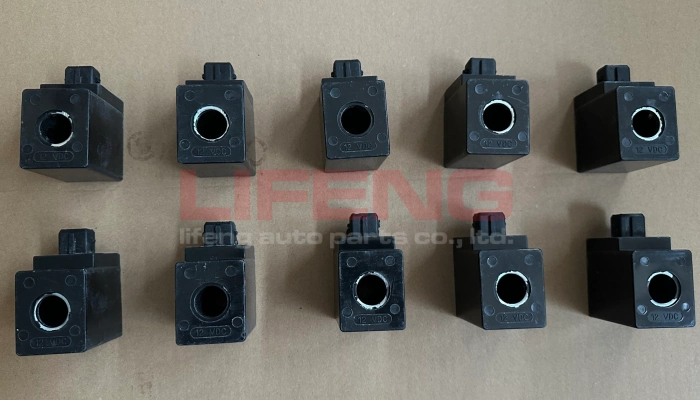
replacement solenoid valve coil, 12V and 24V compatible
What It Means If Your Reading Is Out of Range
- Reading is 0Ω (dead short):the coil winding has shorted internally. Replace it — this isn’t fixable in the field.
- Reading is infinite/no continuity (open circuit):the winding has broken internally, often from heat damage or vibration fatigue. Replace it.
- Reading is within range but the valve still doesn’t actuate:the coil itself may be fine — the problem is more likely in the wiring, connector, or ECU driver circuit. See our guide on How to Test an Excavator Solenoid Valve for the full diagnostic sequence, and Symptoms of a Bad Hydraulic Solenoid Coil for other signs to check.
Common Mistakes When Reading These Specs
- Checking resistance but ignoring voltage.A coil can measure “in range” on resistance and still be the wrong voltage rating for your system — always confirm both.
- Installing a 12V coil on a 24V system (or vice versa).This is one of the fastest ways to destroy a brand-new part; the coil may work briefly before overheating and failing.
- Mixing spec sheets across ECU generations.Older and newer versions of the same machine can use different coil specs even when the part looks identical — don’t assume a spec chart from one production year applies to all of them.
- Treating general ranges as exact figures.The chart above is a starting point for a quick health check, not a substitute for the OEM spec on your specific part number.
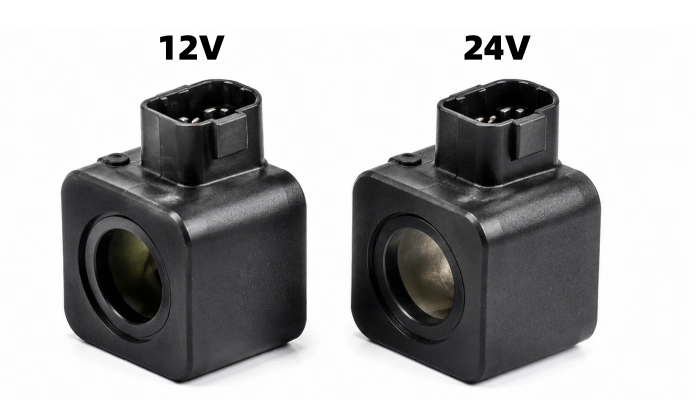
12v-24v-solenoid-coil-comparison
Need Help Confirming Your Exact Spec?
If your reading is borderline, or you just want to confirm you’re ordering the right coil before you buy, send us your machine’s model and serial number — or a photo of the part number on the old coil — and we’ll match it against the correct spec. Get in touch here.
Related reading: How to Test an Excavator Solenoid Valve · Symptoms of a Bad Hydraulic Solenoid Coil · OEM vs Aftermarket Solenoid Valve Coils
