 English
 简体中文
简体中文
 ru
ru
 es
es

JCB Solenoid Valve Fault Codes Explained (3CX/4CX Series)
If your JCB 3CX or 4CX has thrown a fault code and you suspect a solenoid valve is behind it, this guide breaks down how JCB’s diagnostic system displays these codes, what the solenoid-related codes typically mean, and the steps to confirm whether the coil itself — or something else in the circuit — is causing the problem.
Note: Fault code numbering can vary between ECU generations (Tier 3, Tier 4, Stage V) and machine serial number ranges. Always confirm the exact code against your machine’s diagnostic tool or JCB service documentation before ordering parts — this guide explains the code logic and common failure patterns, not a single universal list.

JCB 3CX 4CX backhoe loader solenoid valve fault code diagnosis
How JCB Fault Codes Work
JCB machines built from the mid-2000s onward use an electronic control system that continuously monitors solenoids, sensors, and actuators across the hydraulic, engine, and transmission systems. Depending on the model year and ECU generation, faults appear in one of two ways:
- Older/Tier 3 machines: a numeric code (often 3 digits) shown on the dashboard alongside a short abbreviated description, e.g. “221 SLW BRK.”
- Newer Tier 4/Stage V machines: a longer alphanumeric code similar to an automotive OBD-II format (e.g., P0xxx or Exxx), viewable on the digital display or pulled via a diagnostic scanner.
On most 3CX/4CX models, the diagnostic port is a 9-pin connector located in the cab, typically under the seat or behind the side console panel.
Each fault code generally falls into one of two electrical fault types:
- Open circuit– the ECU detects no current flow, usually pointing to a broken wire, corroded connector, or a burned-out coil winding.
- Short circuit– the ECU detects excess current draw, usually pointing to damaged wire insulation, water ingress, or an internally shorted coil.
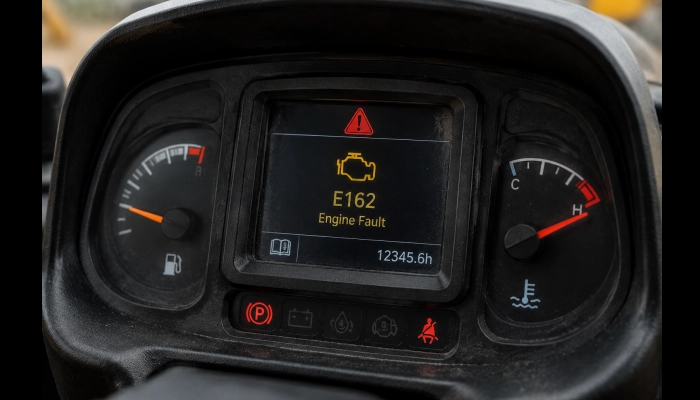
JCB 3CX 4CX 9-pin diagnostic port location under seat
Common Solenoid-Related Fault Categories on 3CX/4CX
Rather than memorizing exact digits (which shift between software versions), it’s more useful to know which functions are commonly flagged. On the JCB platform, solenoid-related diagnostic codes typically cluster around these systems:
| Function | What the Solenoid Controls | Typical Symptom When Faulted |
| Max flow / pump control solenoid | Regulates hydraulic pump output flow | Sluggish or jerky hydraulic response |
| Slew brake / slew shut-off solenoid | Controls slew (swing) braking and lockout | Slew drifts, won’t hold position, or won’t move at all |
| Travel/shift solenoid | Controls travel speed range shifting | Machine stuck in one gear range, harsh shifting |
| Throttle solenoid | Controls engine throttle actuation | Engine won’t rev, stuck at idle or high RPM |
| Boom priority/boom speed solenoid | Regulates boom function priority and speed | Boom moves too fast/slow, uneven function priority |
| Hydraulic fan solenoid | Controls cooling fan drive | Overheating, fan running constantly or not at all |
If your fault code display references any of these functions, it’s very likely tied to a solenoid valve or its wiring rather than a purely mechanical issue.
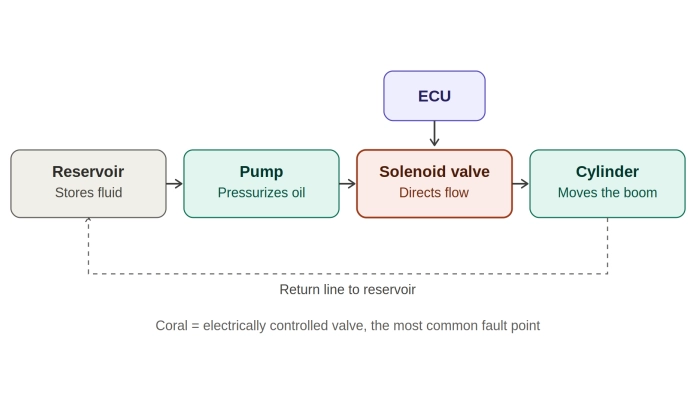
jcb-hydraulic-solenoid-valve-diagram
Fault Code Doesn’t Always Mean a Bad Coil
This is the part operators most often get wrong: a solenoid fault code confirms an electrical fault in that circuit — not necessarily that the coil itself has failed. In practice, the fault can come from:
- A corroded or loose connector pin at the solenoid plug
- Chafed wiring insulation from vibration or heat exposure
- Moisture ingress into the connector housing
- The coil winding itself being open or shorted
Skipping straight to a coil replacement without checking the wiring is one of the most common reasons operators end up replacing a solenoid coil and still seeing the same fault code afterward.
Step-by-Step Diagnostic Process
- Record the code, then clear it.Note the exact code/abbreviation shown, then clear the fault (many minor codes can be reset by disconnecting the battery for about 30 minutes; emissions-related derate codes usually need a JCB-compatible scan tool).
- Check if the code returns.Run the machine through the affected function. If the code reappears immediately, the fault is active, not historic.
- Test coil resistance.Disconnect the solenoid connector and measure resistance across the coil terminals with a multimeter. Compare against the OEM spec for that valve (typically in the low ohms range for most hydraulic solenoids) — a reading of zero or infinite ohms usually confirms a bad coil.
- Check supply voltage at the connector.With the connector still disconnected and ignition on, verify the ECU is sending the expected voltage to the circuit. No voltage points to a wiring or ECU-side issue rather than the coil.
- Inspect the connector and harness.Look for corrosion, bent pins, or chafed insulation along the harness run, particularly near pivot points and cable ties.
- Reconnect and retest.If the coil tests within spec and the harness looks clean, the issue may sit further upstream (ECU driver circuit) and is worth having checked by a dealer or qualified technician.
Clearing and Resetting Codes
Most non-emissions solenoid fault codes clear automatically once the underlying issue is fixed and the machine completes a normal operating cycle. If a code persists:
- Disconnect the battery for 30 minutes to force an ECU reset (works for many minor codes).
- Emissions-related “Derate” codes typically require a JCB Service Master tool or compatible diagnostic scanner to clear properly, since the ECU stores them as confirmed faults rather than transient errors.
When to Replace the Solenoid Coil
If coil resistance is out of spec, the connector and harness test clean, and supply voltage is present but the coil still doesn’t actuate, replacement is the next step. At that point the real decision is sourcing the right part — see our guides on OEM vs Aftermarket Solenoid Valve Coils and How to Find the Right Solenoid Valve Part Number for JCB, CAT, Bobcat, John Deere, Case & New Holland to make sure you order the correct coil the first time.
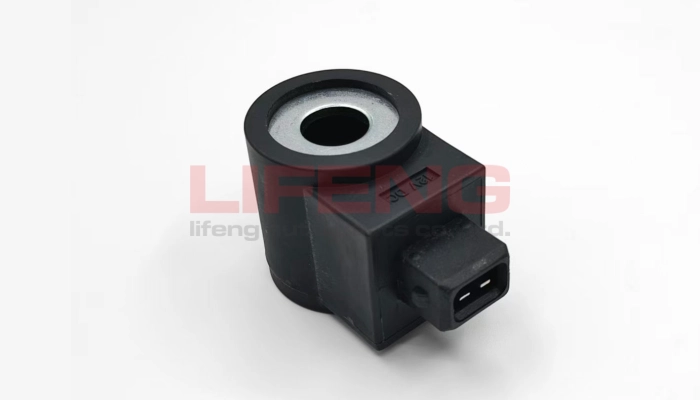
JCB solenoid valve coil replacement part 25974641
Related reading: Why Excavator Solenoid Valve Fails: 7 Root Causes · Symptoms of a Bad Hydraulic Solenoid Coil · How to Test an Excavator Solenoid Valve
